Australia's mmWave Expansion Stalled. Why Is Canada Auctioning It?Thursday, 2026-Sep-17
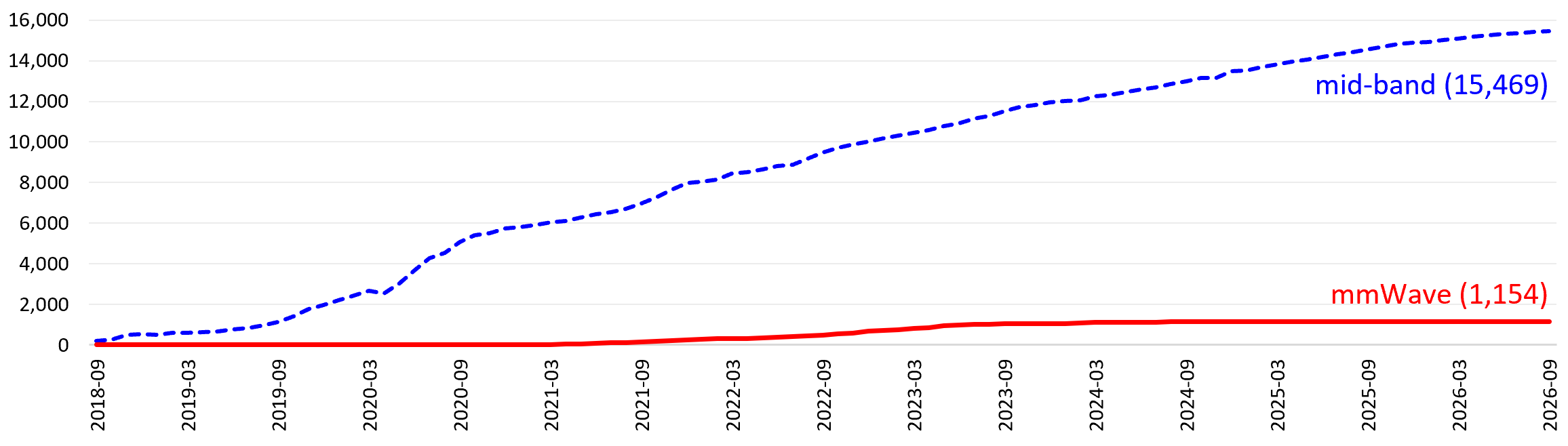
Over the past 6 months, Australia's 3.4 GHz mid-band site count rose by 378, while its 26 GHz mmWave site count fell by 2.
Canada plans to
auction mmWave spectrum in 2027.
Australia's stalled mmWave rollout provides a timely test of whether mmWave can support sustained public-mobile deployment.
mmWave was supposed to add capacity in crowded places where existing mobile networks become congested.
Australia's operators deployed it, but site growth has now effectively stopped.
Vodafone, Telstra and Optus had all deployed mmWave by 2021.
Net annual mmWave site growth peaked at 545 in 2022–23, then fell to 95 in 2023–24, 20 in 2024–25 and zero in 2025–26.
The graph below shows mid-band continuing to grow past 15,000 sites while mmWave flattened just above 1,000.
Cellular Sites (Australia)
Source: ACMA Radiocomms licence data (to 2026-Sep-17)
Indoor and low-power deployments may not appear in these counts.
Australia is not alone.
South Korea, another early 5G market, expanded mid-band widely but failed to build mmWave at comparable scale despite assigning the spectrum in 2018, imposing build requirements, funding pilots and promoting subway Wi-Fi backhaul.
Even so, operators met only about 10% of the required 28 GHz buildout, and
the regulator cancelled
the mmWave assignments of LG Uplus and KT in 2022,
later cancelling SK Telecom's as well.
The deployment record in both Australia and South Korea suggests that operators did not find enough additional locations worth building.
Site Counts Understate the Coverage Gap
Australia has 15,469 mid-band sites and 1,154 mmWave sites, a ratio of 13-to-1. But site counts understate the coverage gap. mmWave delivers high capacity over short distances and is highly sensitive to buildings, foliage and other obstructions; it functions more as a hotspot layer than broad-area coverage.
For illustration, if mmWave reaches 200 m while mid-band reaches 2 km, mid-band reaches 10 times farther and covers roughly 100 times the area. Actual footprints vary, and that does not mean each mid-band site earns 100 times the revenue. It means each mmWave site must capture enough traffic within its small service area to pay for equipment, mounting, backhaul and operating costs.
Net Change in Sites (Sep-Sep)
Period
mid-band
mmWave
2018-19
945
n/a
2019-20
3,918
n/a
2020-21
1,895
133
2021-22
2,531
361
2022-23
2,027
545
2023-24
1,475
95
2024-25
1,572
20
2025-26
905
0
Why Expansion Likely Stopped
For a public mobile network, the economics generally work only where heavy traffic, a clear enough signal path, affordable mounting, available backhaul and compatible phones and devices all line up—and where no cheaper alternative such as mid-band densification or Wi-Fi is available.
Australia's buildout suggests that operators found some locations meeting those conditions, but not enough to sustain expansion.
What This Means for Canada
Australia's experience raises the obvious question: if operators tried mmWave there and then stopped expanding it, why should Canada expect a different result?
Australia had spectrum, operators and several years to identify viable locations.
Its rollout suggests that operators did not find a sustained business case for adding more mmWave sites.
Canada's own
licensing framework
acknowledges uncertainty around current business cases for mmWave technology, and gives licensees 9.5 years to meet deployment requirements.
Canada is entering mmWave late, after other advanced markets have already exposed mmWave's weak business case for broad public-mobile deployment.
Unless Canada has better deployment economics than Australia did, its mmWave auction risks the same fate.
Ottawa can auction spectrum and collect proceeds, but neither an auction nor a licence creates network demand.
If mmWave cannot justify sustained buildout, the outcome is licensed spectrum with unknown subscriber value.
Conclusion
Annual mmWave site growth peaked in 2022–23 and then collapsed, leaving the cumulative site count nearly flat.
Before auctioning these bands, Canada should explain what will make its deployment economics materially different from Australia's.
All 3,132 Terrion Sites Now in Canada Cellular ServicesTuesday, 2026-Jul-28
Canada Cellular Services now includes Terrion's complete portfolio of 3,132 wireless infrastructure sites, together with site attributes, tenants, and licensed radio emissions.
We have tracked Terrion's public site database and expanded our coverage as new locations became available. Until now, however, the published portfolio remained incomplete and many sites lacked basic attributes.
Terrion has now released a substantially improved database. Canada Cellular Services has incorporated all 3,132 locations, including site names, addresses, structure types, and site heights.
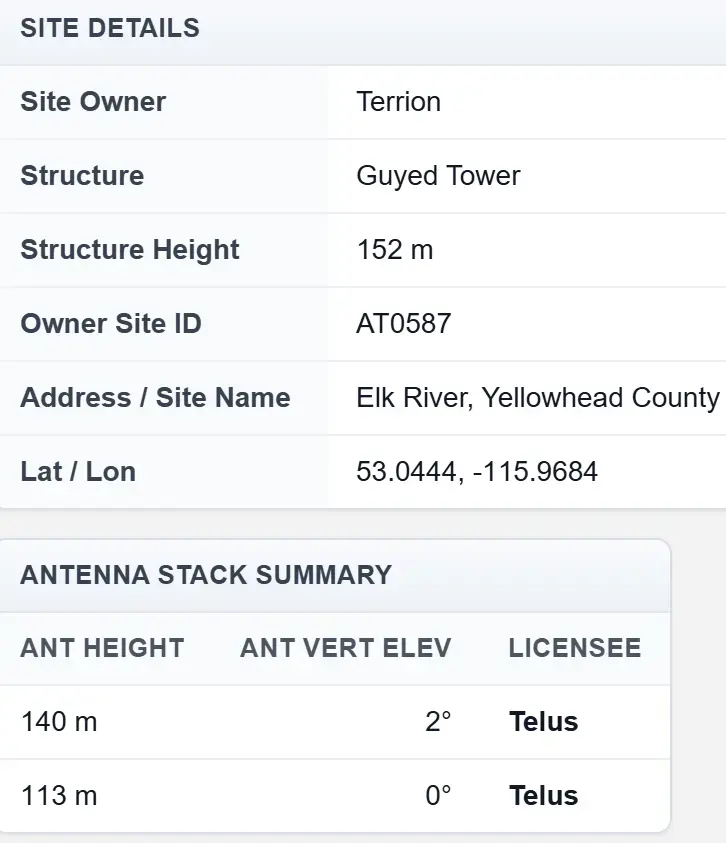
Users can see the carriers operating from the site, their licensed radio emissions, antenna mounting heights, and tenant stacking. Sites can also be filtered as Terrion, Terrion Solo, or Terrion Co-lo.
Canada Cellular Services also includes 583 Aurora Towers sites and 121 Shared Tower sites, bringing the total independent towerco inventory to 3,836 locations in one searchable platform.
Subscriptions of 1 month or longer are non-refundable.
The 48-hour subscription provides short-term access to Cellular Services at a low cost. A refund for a 48-hour subscription is available only if no user signed in during the subscription period.
3D Fresnel Zone KML Generator subscriptions are non-refundable.
You can use this service for free with limited functionality, including changing fields in the green zone but not the blue zone, to determine whether it meets your needs.
If a subscriber is unable to access Cellular Services or 3D Fresnel Zone KML Generator because of a verified service issue within Loxcel's control, we may extend the subscription period by a reasonable period corresponding to the verified service unavailability.
This extension is the only remedy available to you; there are no full or partial monetary refunds.
Subscriptions provide access to use the services during the subscription period. They do not transfer ownership of Loxcel software, data, maps, methods, or other intellectual property, and do not permit resale, redistribution, automated extraction, scraping, or bulk copying except as expressly allowed by Loxcel.
By purchasing a subscription to any service mentioned above, you indicate that you understand and agree to all terms listed above.
Please
contact us
if you have any other questions.
3D Fresnel Zone KML Export UpdatedFriday, 2026-May-08
Optimize wireless links in
Google Earth Web
with guided views, site antenna models, and improved Fresnel-zone visibility.
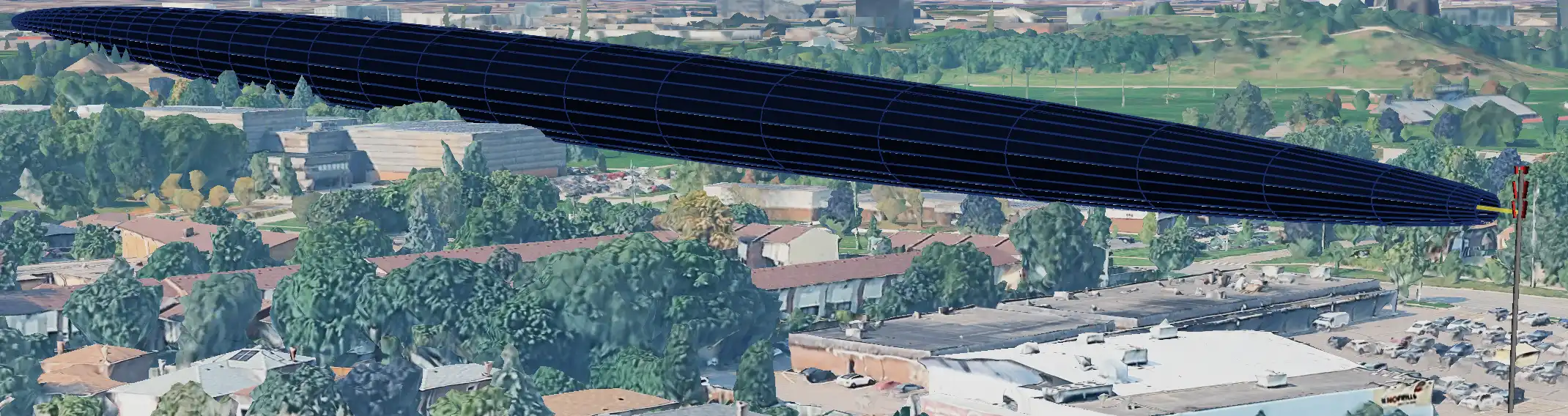
A wireless link depends on more than a clear line of sight. Around that line is the Fresnel zone: a 3D area where terrain, trees, or buildings can still affect the signal. If too much of that zone is blocked, capacity and reliability can suffer.
Google Earth Web can make that hidden Fresnel zone visible over real terrain. Instead of relying only on a path profile, users can rotate around the path and see where terrain, trees, or buildings may begin to affect link quality.
Loxcel has supported this kind of visual path review for years through its 3D Fresnel Zone KML export, both after
Find Best
identifies candidate cellular sites and in the standalone
RF Link & Fresnel Zone KML Tool
when both endpoints are already known.
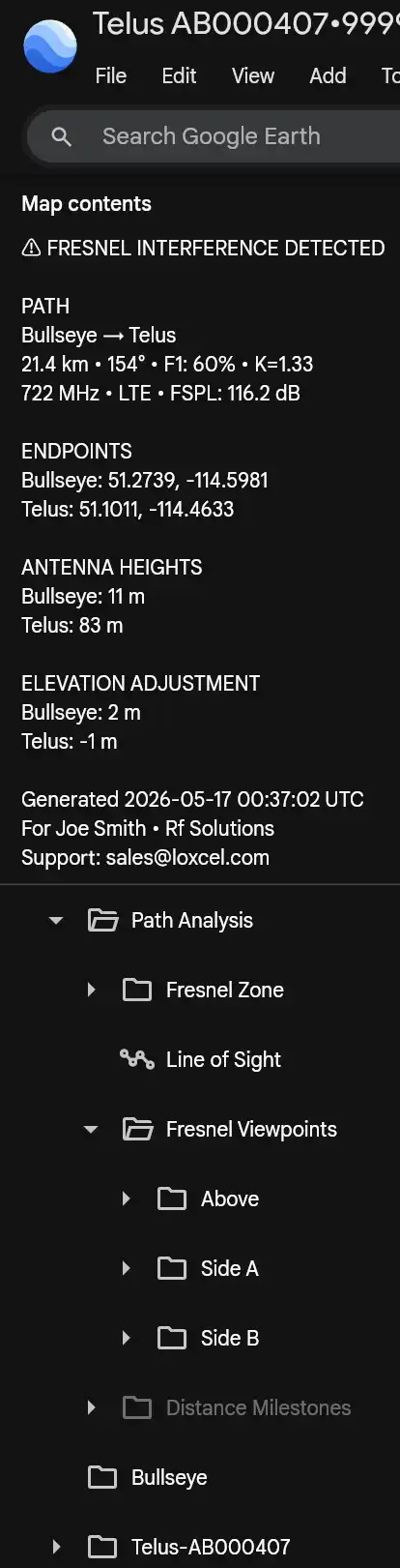
The updated export makes that Google Earth workflow much more useful. The KML now opens with a readable path summary and a better-organized folder tree. It also adds guided viewpoints, site geometry with antenna panels, upper and lower Fresnel rendering, endpoint elevation adjustment, and free-space path loss.
In addition to line of sight, Fresnel geometry, and milestones, the export now gives users a fuller RF inspection view around the path.
Improved Path Summary
The KML description panel has been updated for Google Earth Web.
It now shows key path details: distance, bearing, Fresnel percentage, K-factor, frequency, free-space path loss, endpoint coordinates, antenna heights, elevation adjustments, and support contact.
That keeps the RF context visible while users review the terrain, line of sight, Fresnel zone, viewpoints, and site geometry.
Endpoint Elevation Adjustment
Google Earth’s terrain and Loxcel’s elevation source are not always identical at endpoint locations.
Because the KML geometry is positioned using above-sea-level (ASL) elevation, a difference between the two terrain models can make the line of sight and Fresnel zone appear too high or too low relative to Google Earth’s visible ground.
The updated KML export includes Bullseye and Site elevation adjustments for 3D KML.
You can tune each endpoint to align the line of sight and Fresnel zone with the Google Earth scene.
Fresnel Views Built for Inspection
The KML now includes a Fresnel Viewpoints folder with views from above and from both sides of the path, plus optional camera views at distance milestones.
Users can review the path step by step from one endpoint to the other, making it easier to check the entire route.
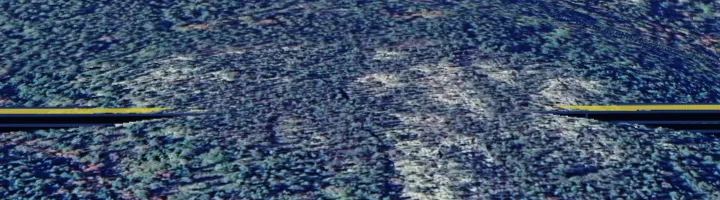
More importantly, the top half of the Fresnel zone can be turned off while the bottom half remains visible. That small change makes obstruction checks much easier because terrain, trees, or buildings are no longer hidden behind the upper surface.
Improved Path Summary
Terrain obstruction is visible with the Fresnel top half hiddenTerrain obstruction is obscured with the Fresnel top half shown
Google Earth Web view showing the line of sight, Fresnel zone, and donor site geometry in terrain context.
Better Google Earth Web RF Inspection
Together, these updates make the KML export more useful in Google Earth Web.
Users can review the path, inspect Fresnel clearance, adjust endpoint elevation, and keep RF context visible while working directly in Google Earth Web.
Finding Tower Space in Canada Just Got EasierWednesday, 2026-Apr-08
Finding tower space in Canada has never been straightforward. Canada Cellular Services changes that by bringing 3,520 towerco sites into a single searchable platform, alongside carrier emissions, tenant occupancy, and vertical antenna stacking.
3,520 independently owned sites, in one place
Canada Cellular Services now includes tower portfolios from Terrion (2,816 sites), Aurora Towers (583 sites), and Shared Tower (121 sites) — bringing 3,520 independently owned tower locations into a single searchable environment alongside Canada's wireless infrastructure.
Users can filter directly by owner, or by tenancy status: Vacant, Solo (single-tenant), or Co-lo (multi-tenant). The result is an immediate, actionable view of where co-location capacity exists across the country.
What a tower company is, and why it matters
In the United States and across Europe, tower ownership and wireless network operation separated long ago. Companies like American Tower, Crown Castle, and SBA Communications own the physical infrastructure. Carriers lease space on it. Towers are designed from the outset to host multiple tenants, approval processes are streamlined, and operators can focus capital on spectrum and network rather than steel and concrete.
Canada has been slow to adopt this model. Only 10% of towers in this country are owned by independent tower companies. The major carriers — Bell, Rogers, and Telus — have historically owned the towers they use, and that concentration has made infrastructure access difficult for smaller operators and new entrants alike. Terrion, Aurora Towers, and Shared Tower are changing that, and their portfolios are now fully integrated into Canada Cellular Services.
Why co-location changes the deployment calculus
A conventional tower build in Canada — site selection, municipal consultation, permitting, community opposition, construction — routinely takes twelve months or more. NIMBYism is real, and it is expensive. Terrion advertises 30-day co-location approval on existing structures. That's the difference between 30 days and 365. For an MNO trying to densify a network or deploy new spectrum, that is not a marginal improvement. It is a fundamentally different operating model.
The towerco model works because the infrastructure is designed for shared use from the start. Towers are sized and structured to accommodate multiple tenants stacked vertically, each at its own mounting height, azimuth, and tilt. The tower company handles the structure; the carrier handles the radio.
What Canada Cellular Services shows you
Knowing a towerco site exists is only the beginning. The harder questions are: who is already on the tower, where are they positioned, and is there room for another tenant without compromising signal quality? Canada Cellular Services shows who is on each tower, where they are mounted, and whether space remains for additional tenants without interference risk.
For each site, users can identify existing tenants, distinguish vacant from occupied structures, view antenna stacking positions by tenant, assess mounting height, azimuth, and vertical tilt, and evaluate vertical separation between tenants — the critical factor in managing interference between co-located carriers.
Each site can also be
exported as a 3D KML model. Panels are color-coded by tenant, positioned at actual mounting heights, oriented by azimuth, and scaled by frequency band — higher frequencies appear as shorter panels. This gives site acquisition teams and RF planners a concrete picture of available space and deployment constraints before a single site visit is scheduled.
For tower companies, this is not just visibility — it is distribution. Canada Cellular Services is used by carriers and site acquisition teams to identify deployment opportunities. Ensuring that a portfolio is accurately represented — including structure attributes, tenancy visibility, and availability — directly improves how sites are evaluated for co-location.
For operators and investors
The towerco model generates long-term contracted revenue with inflation-linked escalators and low tenant churn — which is why it attracts serious institutional capital. Northleaf Capital committed C$100 million to Shared Tower in early 2025. Canada's towerco sector is early and the inventory is still being built. For private equity and infrastructure investors, understanding what exists today — where sites are, who occupies them, and what capacity remains — is the starting point for any credible analysis.
Loxcel has been mapping Canada's wireless networks for over 15 years
Canada Cellular Services is not a new entrant to this data. Loxcel has spent more than fifteen years building and maintaining the most detailed picture of Canada's wireless infrastructure available anywhere — carrier emissions, spectrum licenses, antenna configurations, and site-level detail. The towerco integration adds a new layer to a dataset that operators, regulators, and investors have relied on for well over a decade.
No other platform in Canada currently offers this combination: independent towerco inventory, carrier emission data, tenant identification, and 3D site visualization — in a single searchable environment.
Canada Cellular Services is the starting point for identifying tower co-location opportunities in Canada.
We have updated our backoffice workflow that ingests ISED Spectrum Management System (SMS) data.
The result is a stronger, cleaner, and more defensible national data foundation powering our reports and the
Canada Cellular Services platform.
Innovation, Science and Economic Development Canada (ISED) manages Canada's radio spectrum. Licensees submit technical RF data into ISED’s Spectrum Management System (SMS), and ISED publishes those submissions as
monthly downloads
that appear to be national snapshots of Canadian spectrum deployments. They are not. ISED has publicly acknowledged the need to improve data quality, reliability and uniformity within SMS.
In practice, SMS is a cumulative record of submissions rather than a clean monthly replacement of what changed. Older records linger, and updates may appear late or not at all. Months with no visible change do not mean the network is stable — they often mean no new submissions were processed. The transactional UPDATE / APPEND / REPLACE nature of the
submission process
adds further risk. Treating each monthly file as a clean snapshot leads to unreliable conclusions. Serious longitudinal analysis must reconcile cumulative submissions, upload chronology, and transactional overwrite events.
Our updated workflow is built around that reality. We reconcile cumulative submissions into coherent state transitions, filter stale and superseded records, remove structural duplicates, resolve site relocations, detect anomalous overwrite events, and restore (backfill) emissions when valid spectrum is temporarily removed due to transactional errors. The result is an operational representation of Canada’s wireless infrastructure — not a raw administrative extract.
The workflow is now live and continues to be refined as we identify edge cases and resolve residual inconsistencies.
The ISED SMS files are free. Extracting reliable network intelligence from them is not.
For RF technicians, operators, and site acquisition or investment firms, the risk isn’t downloading the data. The risk is making decisions based on it at face value.